The Life-Giving Work of the Spirit: Regeneration
Thursday, January 3rd, 2008In my post "Total Depravity 2," I concluded it by noting that the nature of a person’s total depravity demands that God must regenerate a sinner if he is to have any hope of eternal salvation. This is to say that without the Spirit’s work in regeneration, a person is helplessly condemned to an eternal condemnation. I also concluded my post by drawing your attention to some helpful sources on the doctrine of regeneration. However, to complete my description of regeneration, I would like to add a few additional observations.
If you have been following what I am arguing for with the doctrine of totally depravity, then no one be saved? What this means, contrary to modern expectations, is that not even a counselor can save a totally depraved sinner. With any person it is impossible for this person to save himself; however, with God all things are possible (Matt 19:25 [show]Matthew 19:25
[25]When the disciples heard this, they were greatly astonished, saying, "Who then can be saved?" (ESV)
–26). Only God can change a person’s totally depraved heart of stone into a renewed heart of flesh (Ezek 36:26). It does not matter whether one lived before or after the Cross, or even where they lived, there is only one way to overcome spiritual death, and this is by God giving a dead sinner spiritual life. By the very nature of total depravity, no one has the desire or capability to come to God. Jesus recognized the ramifications of a person’s total depravity when he said to Nicodemus in John 3:3, 5 [show]John 3:3
[3]Jesus answered him, "Truly, truly, I say to you, unless one is born again(1) he cannot see the kingdom of God." (ESV)
John 3:5
[5]Jesus answered, "Truly, truly, I say to you, unless one is born of water and the Spirit, he cannot enter the kingdom of God. (ESV)
Footnotes
1. [3:3] Or 'from above'; the Greek is purposely ambiguous and can mean both 'again' and 'from above'; also verse 7
that “unless one is born from above he cannot see the kingdom of God…. Unless one is born of water and the Spirit he cannot enter into the kingdom of God." Jesus again recognized the necessity of God enabling man to believe in John 6:44, 65 [show]John 6:44
[44]No one can come to me unless the Father who sent me draws him. And I will raise him up on the last day. (ESV)
John 6:65
[65]And he said, "This is why I told you that no one can come to me unless it is granted him by the Father." (ESV)
: “No one can come to Me unless the Father who sent Me draws him…. No one can come to Me unless it has been granted him from the Father.” In both passages, Jesus recognizes the absolute impossibility of man creating in his own being any type of spiritual life so that he could come to God, and he affirmed that it is only through divine enablement that anyone can come to God. Of necessity, Jesus’ remarks in both passages affirm that if anyone is to faithfully follow Him, a person will only come because the Divine Progenitor has given him spiritual life. Just as it is impossible for any person to cause his own physical birth, so it is impossible for any depraved person to bring about his own spiritual birth. The term that theologically describes this “monergistic” work of God in the soul of a radically corrupt sinner is regeneration. In both contexts, Jesus emphatically rules out any type of synergistic activity with God and man cooperatively working together to produce new life (see Hoekema, Saved by Grace, p. 101). Since total depravity has been the true state of man since the Fall, Jesus’ remarks strongly suggest that fallen humanity can only come to a saving knowledge of God through the Spirit’s life-giving work in regeneration.
Regeneration may be defined as an implanting of spiritual life in the spiritually dead. Such a definition is certainly related to the biblical description of man as being “dead in trespasses and sin.” More specifically, regeneration involves the impartation of a new disposition, a new complex of attributes, including spiritual life, in a pervasively corrupt man. In keeping with this, regeneration, according to Berkhof, “is that act of God by which the principle of the new life is implanted in man, and the governing disposition of the soul is made holy” (Systematic Theology, 2:469). If this governing disposition is correlated with the new nature (see Combs, “Does the Believer Have One Nature or Two?” pp. 82–87), regeneration can be defined as “the decisive impartation of the new nature to a spiritually dead man" (Snoeberger, “Priority of Regeneration to Saving Faith,” p. 55). While the Old Testament does not have a Hebrew term that precisely corresponds to the term regeneration, it uses other concepts that overlap with regeneration, such as having “a new heart,” “new spirit,” “heart of flesh” (Ezek 36:26), and a “circumcised heart” (Deut 30:6 [show]Deuteronomy 30:6
[6]And the LORD your God will circumcise your heart and the heart of your offspring, so that you will love the LORD your God with all your heart and with all your soul, that you may live. (ESV)
; Jer 9:25 [show]Jeremiah 9:25
[25]"Behold, the days are coming, declares the LORD, when I will punish all those who are circumcised merely in the flesh-- (ESV)
; Ezek 44:7, 9). In the New Testament, the term regeneration is only used in Titus 3:5 [show]Titus 3:5
[5]he saved us, not because of works done by us in righteousness, but according to his own mercy, by the washing of regeneration and renewal of the Holy Spirit, (ESV)
. Other parallel NT concepts include: “made alive" (Eph 2:5 [show]Ephesians 2:5
[5]even when we were dead in our trespasses, made us alive together with Christ--by grace you have been saved-- (ESV)
, Col 2:13 [show]Colossians 2:13
[13]And you, who were dead in your trespasses and the uncircumcision of your flesh, God made alive together with him, having forgiven us all our trespasses, (ESV)
“born" (John 1:13, 1 [show]John 1:13
[13]who were born, not of blood nor of the will of the flesh nor of the will of man, but of God. (ESV)
John 1:1
The Word Became Flesh
[1:1]In the beginning was the Word, and the Word was with God, and the Word was God. (ESV)
John 2:29, 3 [show]John 2:3
[3]When the wine ran out, the mother of Jesus said to him, "They have no wine." (ESV)
:9, 4:7, 5:1), “born again" [or, "born from above"] (John 3:3, 7 [show]John 3:3
[3]Jesus answered him, "Truly, truly, I say to you, unless one is born again(1) he cannot see the kingdom of God." (ESV)
John 3:7
[7]Do not marvel that I said to you, 'You(2) must be born again.' (ESV)
Footnotes
1. [3:3] Or 'from above'; the Greek is purposely ambiguous and can mean both 'again' and 'from above'; also verse 7
2. [3:7] The Greek for 'you' is plural here
) or “born again" (1 Pet 1:3, 23 [show]1 Peter 1:3
Born Again to a Living Hope
[3]Blessed be the God and Father of our Lord Jesus Christ! According to his great mercy, he has caused us to be born again to a living hope through the resurrection of Jesus Christ from the dead, (ESV)
1 Peter 1:23
[23]since you have been born again, not of perishable seed but of imperishable, through the living and abiding word of God; (ESV)
)(see ibid., pp. 53–54). These various terms used for regeneration reflect the initial activity of the Spirit in his life-giving ministry as he implants a new nature in the hearts of men who are spiritually dead. Therefore, regeneration is a soteriological necessity for a fallen man redemption in any era because his corruption permeated his being.
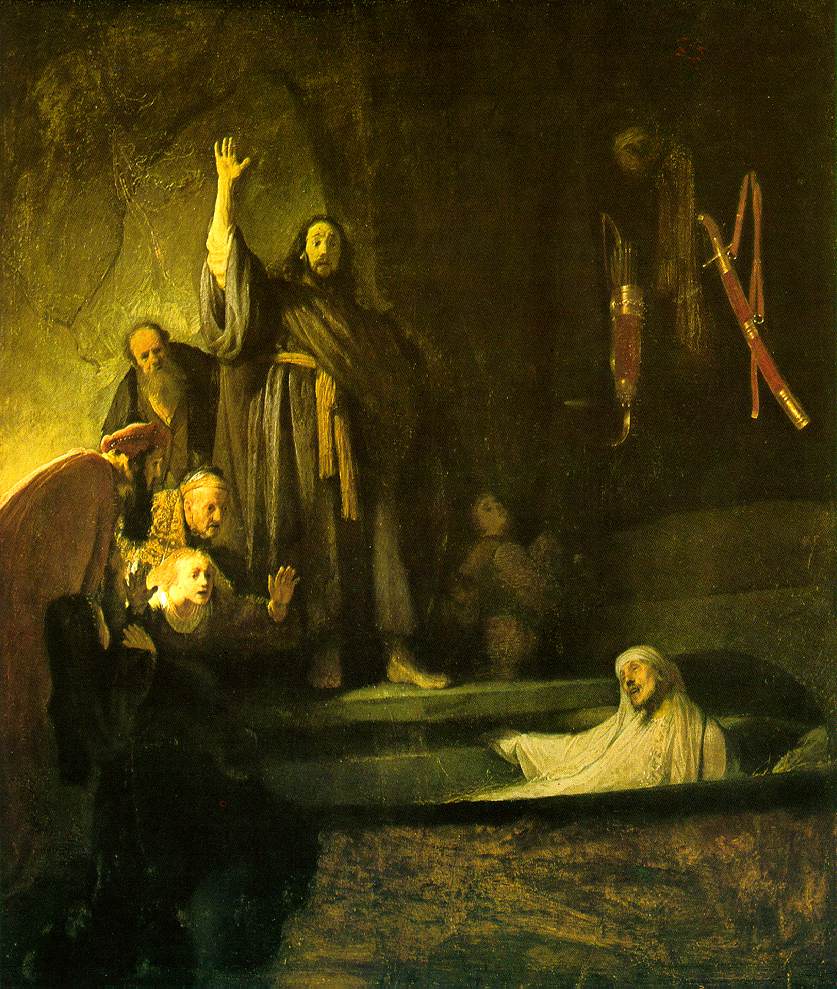
I have included the above picture, The Raising of Lazarus, by the renown 17th century Dutch painter and etcher, Rembrandt Harmenszoon van Rijn, because he places Christ in a prominent place when he raised Lazarus from the dead. In this picture Christ’s role is as it should be for, when Christ raised Lazarus from the dead, Lazarus was a passive recipient in his state of death and Christ was the active agent in creating life in this dead man. Christ’s raising Lazarus from the dead illustrates the point that I am making about regeneration. When the Gospel is preached, the Spirit imparts a new nature to an elect sinner so that the sinner repents of his sin and trusts the finished work of Christ. This is to say, a person does not repent and believe to be born again; rather he repents and believes because he has been born again. Thank God for his monergistic work of regeneration.